Come ready to pitch your statistics article; remember what Teresa advised: “find the story in the numbers”
Your pitch should look (exactly) like this (you will pitch out loud but write it down!):
Proposed headline: A Growing Number of Americans Say, ‘No, Thanks to Children”
Possible subhed: A new study explains why more U.S. adults say they are unlikely to have kids
Story lede: Someone who has decided not to have children.
Nut graph:A new study by the Pew Research Center has found that increasing numbers of Americans have chosen not to raise children. Conducted in 2023, the research notes that 47 percent of those younger than 50 without children said they were unlikely ever to have kids, an increase of 10 percentage points since 2018.
ALSO: We will review structure for a feature based on numbers and how to use statistics as evidence without being boring.
Choose times for speed advising.
Class visit: Erica Edwards, Newmark class of 2014, Solutions Journalism LEDE fellow.
First draft of your profile (w/photo and a quote from someone about your subject) will be due Wednesday March 12 @ 11:59 PM. It goes in this google folder.
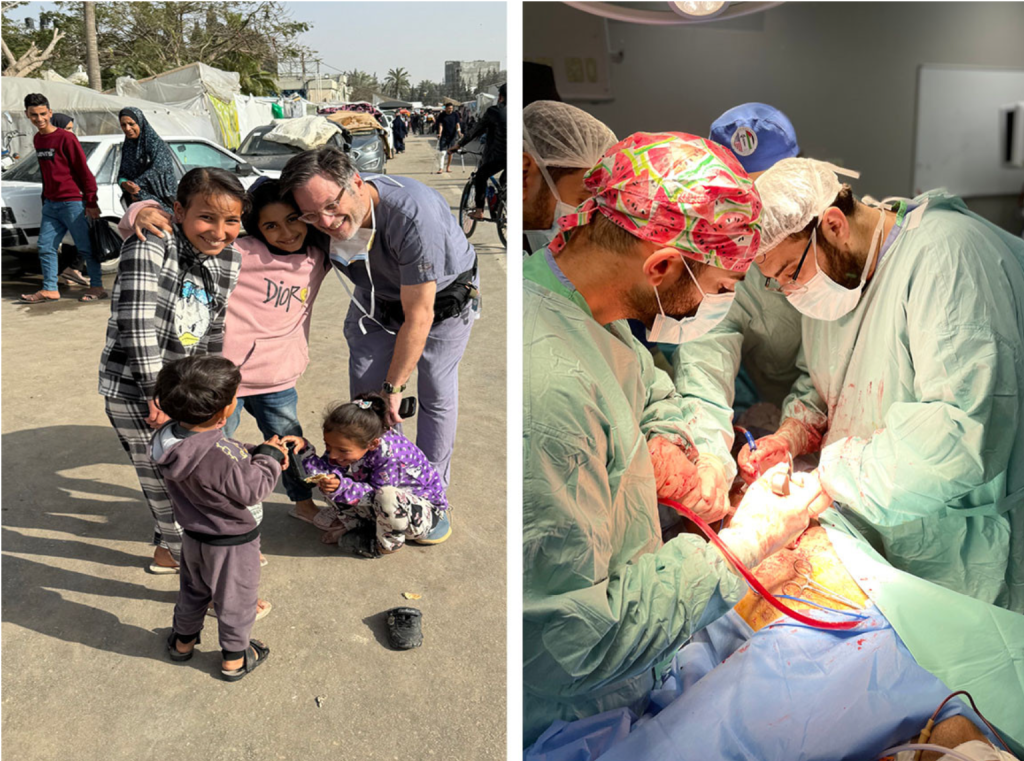
photos from the Politico Magazine piece on doctors in Gaza
Reminder that your feature stories are due at the end of the day Tuesday March 4, 11:59 PM. That’ll give you time to trouble shoot in class next week. If you can post before Tuesday please, please do it. Your revision should go in this google folder.
Reminder that the first draft of your 500- to 700-word newsy feature is due on Friday, end of day or earlier. Put it in this folder. Shelby and I will read and comment as fast as possible, so you have time to revise the stories for a grade.
Here’s what we’ll be looking for:
Proper grammar. This means get rid of passive voice. And use active verbs rather than relying on the “to be” verb (is, are, were etc.). Avoid repetition of words. Here’s a reminder post about grammar rules.
You must have a story lede. Think about the airbnb assignment and start with an anecdotal, not a news, lede.
Correct format. Headline-anecdotal lede-transition-nut graph-body-kicker. You can download the feature story structure ppt from this post.
Attribute quotes. Present tense (says, not said). And state the quote first, followed by the attribution: “I hate strawberries,” says Linda Villarosa. “I don’t like fruit with little seeds.”
Include three sources — at least one expert among them.
Thank you for pitching stories — and apologies for those who weren’t able to get feedback. The fleshed out written version is now due.
Your pitch, for a 500 to 700-world newsy feature story, should be about 200 words long. Make sure to write a headline (and a subhed if you’d like). As you write think “why this story at this time?” In other words, what is new/news? Also briefly sketch out how you plan to report the piece. Put your final in this google doc, with your name in the subject line, by Friday February 7 @ 11:59 PM. Follow the format of the (shortened) pitch for my hair relaxer story below.
Last October, a much-discussed study conducted by the National Institutes of Health found the risk of uterine cancer more than double for women (read Black women) who frequently use hair straightening products compared to those who don’t. Uterine cancer is the most common cancer of the female reproductive system, and the most aggressive subtypes have been on the rise since 2000 – especially among Black women. This research, the first to make this link, adds to a growing body of evidence and mounting concern that straighteners can increase the risk of other hormone-related cancers in women.
The ingredients in hair relaxers are also vastly under regulated. Scientists and others have long known that straightening products used by Black women contain carcinogens and endocrine disrupters that interfere with hormone function. Yet, though Europe bans an estimated 1300 toxic ingredients in beauty products, the United States only prohibits nine. Consumers are left in the dark: a 2018 study found 45 chemicals that can disrupt a woman’s hormones in 18 hair relaxers tested, but 84 percent of these ingredients weren’t listed on the product labels.
A story would examine the link between hair relaxers and cancer and other health problems, the reasons for the lack of oversight by federal regulating agencies and the historical and current societal pressure of Black women to straighten their hair. It would include a class action lawsuit created in response to the new research about the products and their dangers.
Also, come prepared with three ideas for your first assignment — a feature story, based on news/trend of about 500 – 700 words. Be able to state how you came up each idea (why this story at this time?) You will choose one idea as your first assignment.
Don’t forget to put your grammar corrected news event story back in the original google doc by the end of the day Wednesday 1/29 for Shelby and me to review and edit.
Excited to meet each of you! To prepare for our first day of class on Tuesday 1/28, you’ll need to do three things:
In about 300 words, choose a news event and describe how it affected your life. Offer the basics — what happened and when, how did you first find out about it, how it made you feel and why it mattered. Put it in this google doc no later than Friday January 24 @ 11:59 PM. Also, bring a copy to class either on paper or in a digital form for self-editing.
Fill out this survey, again, no later than Friday 1/24. It should take less than 5 minutes.
Please read this story, “The Alienation of Jaime Cachua” which ran in the NYT in December. Come prepared to discuss it the first day of class.
This is a readable long-form feature that deals with relevant, urgent subject matter. In class, we will reflect on the story in terms of form, structure, reporting, writing style and visuals.





 CUNYJfeaturewriting