First draft of your newsy feature is due Sunday 2/15 @ 11:59 PM. It goes in this folder. The final version will be due on Friday 2/27 @ 11:59 PM. Post the final in this folder. Here are the guidelines:
- Your piece should be between 500 to 700 words. It can be a little longer, but not much.
- At best you will need to talk to three people, plus an expert. If you can’t get the expert (extra points if you do!) then pull a quote from a press conference or report, but absolutely not from another news story.
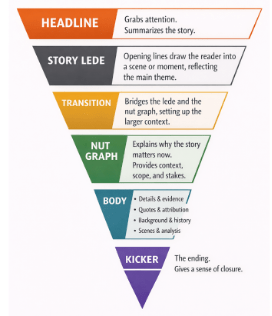
- Follow the format EXACTLY. Headline, story lede, transition, nut graph, body, kicker.
- Use links to research/evidence/reports etc.
- Follow the grammar rules for interesting, active writing. Reminders here.
- Include a source list with phone # and/or email for everyone you interview.
- Correctly attribute quotations. Set up the quote, then use correct attribution and punctuation:
Some people have very specific food preferences. “I hate strawberries,” says Linda Villarosa, a New York City based journalism professor. “I don’t like red food or little seeds. I know it’s weird.”
Here’s a super basic newsy feature — I formatted it for you (and edited out the things I don’t like).
Headline Kids? A Growing Number of Americans Say, ‘No, Thanks.’
Subhed A new study breaks down the reasons more U.S. adults say they are unlikely to have children.
Story Lede
When Jurnee McKay, 25, imagines having children, a series of scary scenarios pop into her mind: the “horrors” of childbirth, risks associated with pregnancy, a flighty potential partner, exorbitant child care costs.
Also on her list of fears: abortion care restrictions. So Ms. McKay, a nursing student in Orlando, decided to eliminate the possibility of an accidental pregnancy. But the first doctor she consulted refused to remove her fallopian tubes, she said, insisting that she might change her mind after meeting her “soul mate.”
“For some reason,” she says, “society looks at women who choose not to make life harder for themselves as crazy.”
Next week, she will speak with another doctor about sterilization.
Like Ms. McKay [nut graph with a transition to link story lede], a growing number of U.S. adults say they are unlikely to raise children, according to a study released on Thursday by the Pew Research Center. When researchers conducted the survey in 2023, 47 percent of those younger than 50 without children said they were unlikely ever to have children, an increase of 10 percentage points since 2018.
Why no kids? Fifty-seven percent said they simply didn’t want to have them. Women were more likely to respond this way than men (64 percent vs. 50 percent). Other reasons included the desire to focus on other things, like their career or interests; concerns about the state of the world; worries about the costs involved in raising a child; concerns about the environment, including climate change; and not having found the right partner.
[earlier Pew study to bulk up evidence] The results echo a 2023 Pew study that found that only 26 percent of adults identified having children as extremely or very important to live a fulfilling life. The U.S. fertility rate has been falling over the last decade, dipping to about 1.6 births per woman in 2023 — the lowest number on record, according to the Centers for Disease Control and Prevention. And it is less than what would be required for the population to replace itself from one generation to the next.
[Anastasia Berg, researcher: Her quote supports nut graph data] The decision to raise kids is shifting from “something that’s just an essential part of human life to one more choice, among others,” said Anastasia Berg, an assistant professor of philosophy at the University of California, Irvine.
[Dr. Berg’s study and her quote ends nut graph] She and Rachel Wiseman, a magazine editor, surveyed nearly 400 people for their new book, “What Are Children For?” and found that many younger people without children were cautiously weighing the pros and cons, worried about how a child would affect their identity and their choices. Many were “averse to embracing the kinds of risks that having children implies,” said Dr. Berg, a millennial and a mother of two.
[body starts here]
[point to support your central idea: not a surprise b/c working women tired of the burden according to Jennifer Glass research] America’s waning desire for children should not come as a surprise, said Jennifer Glass, a professor of sociology at the University of Texas at Austin. Her research, published in 2021, showed that about 70 percent of American mothers would be their household’s primary earner at some point during their first 18 years of motherhood. At the same time, they also devote more time to caregiving than men.
[quote from Dr. Glass] “It’s really an impossible burden,” Dr. Glass said. For some, she added, it can feel as though “there is no way out except a birth strike.”
[Another point: people who don’t have kids seems to be happier than parents] In addition, research has shown that in the United States, people who aren’t parents are generally happier than those who are. Dr. Glass’s 2016 study,which examined the happiness gap in 22 countries, found that the disparity was larger in the United States than in any other industrialized country.
[Another point: having kids = expensive; non parents have more free time and money] In the Pew study, most of those surveyed said that not having kids had made it easier for them to afford the things they wanted, make time for their interests and save for the future.
[Another point: infertility prevents having kids] Others simply don’t have the option of birthing and raising children. Thirteen percent of those surveyed by Pew who were under age 50 said they didn’t plan to have children because of infertility, and 11 percent noted that their partner or spouse did not want kids.
[More on infertility — waited too long; just didn’t happen] The study also included responses from adults 50 and older without kids. The older respondents generally said they didn’t have children because “it just hadn’t happened.”
[This example supports infertility point]“I never actively made a choice to not have children,” said Therese Shechter, a 62-year-old filmmaker in Toronto who spoke to child-free women in the United States and Canada about reproductive freedom and the pressure to have children in her recent documentary “My So-Called Selfish Life.”
In her case, she had a list of things she wanted to accomplish, but being a mother wasn’t on it. Even so, she assumed that one day it would happen.
“I just always felt like that was the thing hanging over my head,” she said. By the time she entered her late 30s, “I realized that, no, I actually didn’t have to do that.”
[Counterpoint: not having kids uncommon] Trey Simmons, 54, said being child-free in his hometown, Augusta, Ga., made him a rarity.
“Most people think I’m off my rocker,” he said. After he and his wife divorced — she also did not want children — he had difficulty finding someone else to date who did not already have kids. Finally, he met someone online who lives in Detroit, and he plans to move there.
“I’ve just never been fond of children at all,” he added.
[Adjacent point: men have fewer qualms and prefer parenthood] On average, research has shown that men appear to have fewer qualms about parenthood. Earlier this year, another Pew study found that among young adults without children, the men — not the women — were more likely to want to be parents someday.
[this expert supports the point about men v women] Corinne Datchi, a professor of psychology at William Paterson University and a couples therapist, said that in her private practice, she was seeing a growing number of women in their 30s who were starting to question whether they should ever have children, while their male partners seemed more open to the idea.
She noted a “level of mistrust,” where the women feel skeptical that their male partners would be willing to sacrifice as much as they would to help raise their families. But apprehension about losing their sense of self and worries about what pregnancy and childbirth would do to their bodies also play a role.
[swing back to the opening example as kicker. Always nice/easy to end with strong quote] As for Ms. McKay, who has already made up her mind to remove her fallopian tubes, she said she would feel relieved when she no longer had to think about the implications of becoming pregnant or raising children.
Getting the procedure “will be a weight off my shoulders,” she said. “I think I’ll feel at peace.”
Christina Caron is a Times reporter covering mental health. More about Christina Caron
 CUNYJfeaturewriting
Leave a comment